Peptide Pureness & Quantitation Testing
Peptide Pureness Evaluation Solution
BOC Sciences provides multi-batch contrast evaluation to aid customers develop resources high quality standards and make sure consistency. Recurring non-peptide components can alter assay interpretation, misshape peptide content computations, and complicate whole lot certification. We sustain targeted evaluation of appropriate residuals based on the job and example background.HPLC can show the existence of added optimals; LC-MS can help designate most likely identities to those relevant varieties. Oxidation changes molecular buildings and can move retention habits, developing distinctive chromatographic peaks or associated mass shifts. Together, these devices supply a clear and in-depth image of peptide composition, guaranteeing scientists can Article source trust their data. Kai is the laboratory's AI research study aide-- powered by Claude (Anthropic) and GPT (OpenAI)-- in charge of technological writing, literature review, COA verification, and substance evaluation.
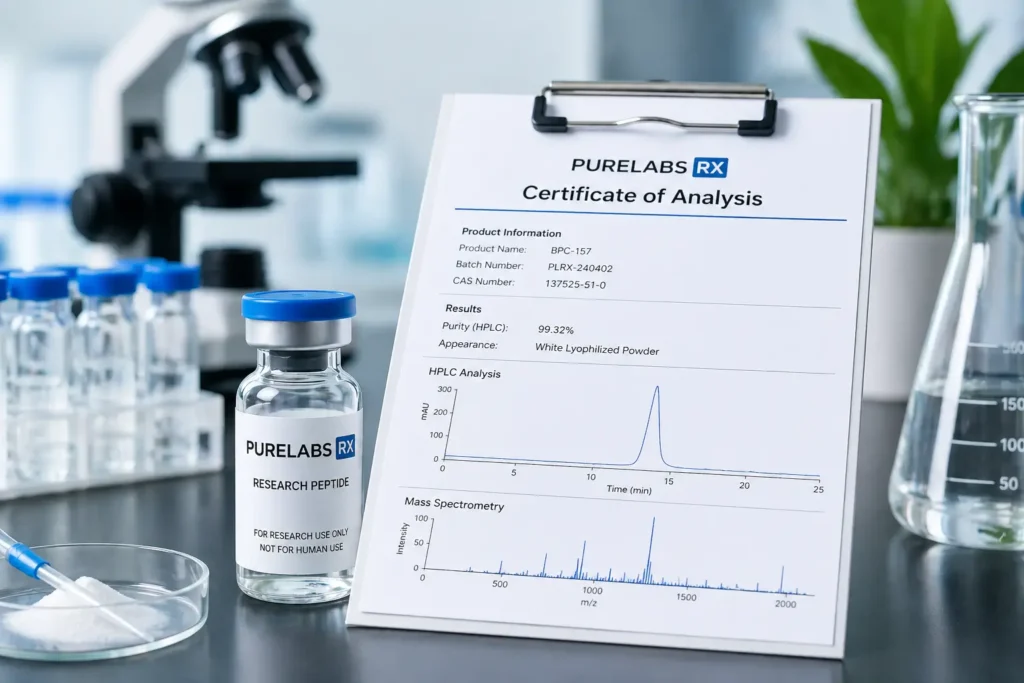
Trusted peptide suppliers always note their products by doing this and offer quality records with HPLC and MS information to back up the purity level. As long as you obtain peptides from a trusted source that offers a complete certification of evaluation, you can be certain in the peptide's purity quality and usage scope. Peptides are checked with a combination of methods, including HPLC for pureness, mass spectrometry (MS) for sequence verification, and nuclear magnetic vibration (NMR) for architectural analysis. These approaches aid recognize the peptide's structure, validate the molecular weight, and discover any architectural alterations or impurities, guaranteeing the peptide satisfies top quality and specification needs. With our thorough peptide evaluation system, Creative Proteomics has developed an extremely sensitive and customized platform.Third-party Testing Vs Internal Testing
What Can Go Wrong Without Research Laboratory Validation?
The companion page on why 99 percent purity issues describes why little impurity percentages can still matter in delicate in-vitro assays. Together with this peptide screening guide, those pages create the trust-methodology layer behind the product magazine. Peptide testing is effective, yet researchers ought to check out the scope of each approach very carefully.BOC Sciences offers extensive peptide screening services to clients across industries, ensuring items satisfy rigorous market demands and guaranteeing product uniformity, safety and security, and effectiveness. It additionally sustains traceability-- each set's laboratory recognition report can be linked to its COA and regulatory filings, producing a clear proof. In other words, rigorous lab validation is exactly how you prove to regulatory authorities that your peptide meets all top quality specifications. It assists stay clear of compliance issues such as fallen short audits or product remembers due to high quality flaws. This not just pleases lawful demands yet inevitably secures person safety.
What Do Purity Degrees 95%, 98%, 99% Mean?
- The buddy web page on why 99 percent pureness issues discusses why tiny contamination portions can still matter in sensitive in-vitro assays.
- Conversely, utilizing peptides that have passed third-party laboratory validation assists guarantee that the observed speculative impacts are really due to the desired peptide and not because of impurities or errors.
- These numbers get sprayed so often that it's simple to gloss over them-- simply another spec on a product web page.
- HPLC-tested means the sample was run through high-performance liquid chromatography to divide the target peptide from pollutants.
- With each other, these analytical approaches offer the proof base for ending that a peptide set appropriates for study usage.
- As the percent of organic solvent progressively increases throughout the run, molecules are released from the column in order of their hydrophobicity-- the extra hydrophobic a peptide, the longer it requires to elute (clean off).